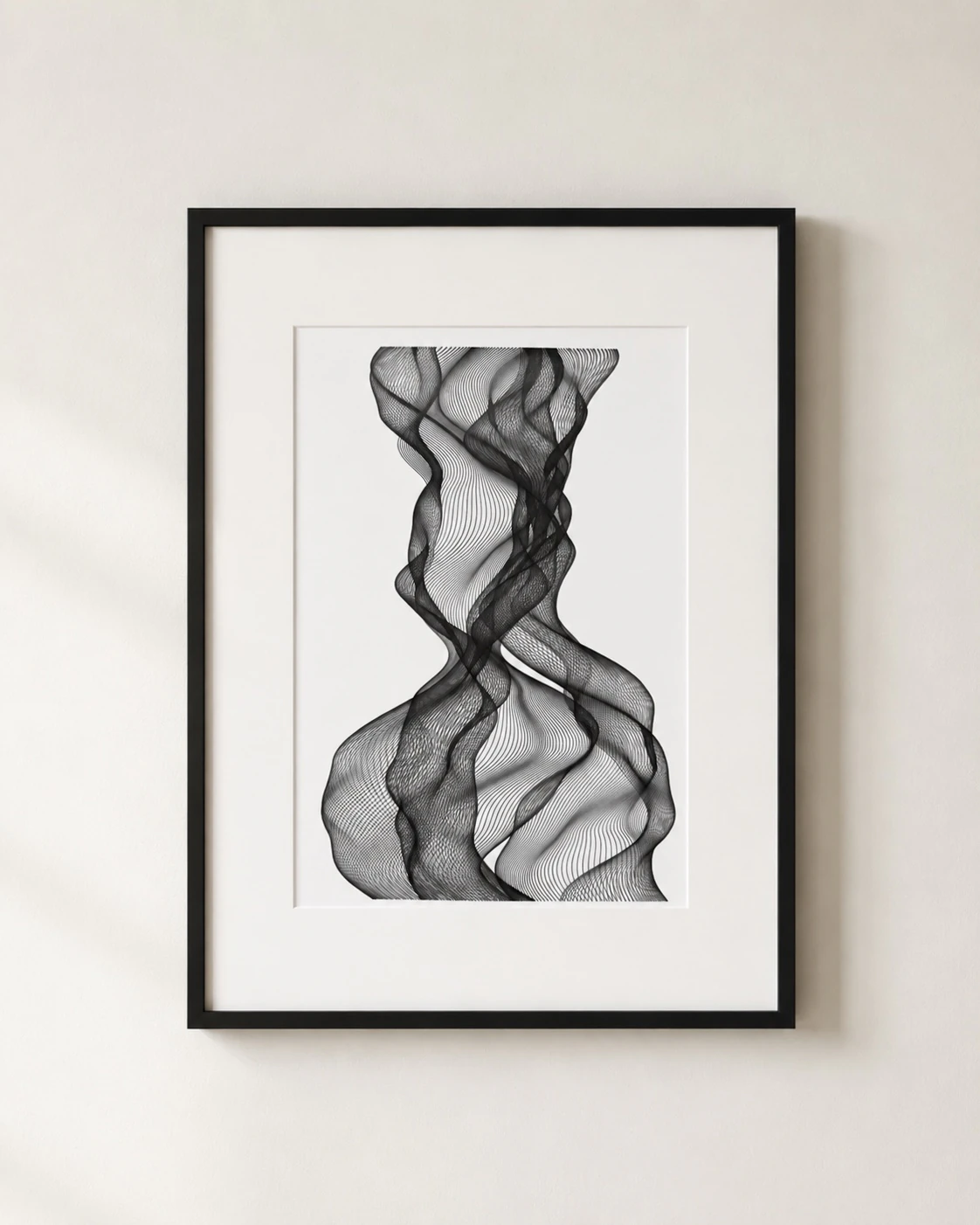
Curves of Her No. 3 framed ink drawing
MaterialsJune 30, 20264 min read

Drawing with a Technical Pen and Plotter

Rotring technical pen, Pelikan ink, and Fabriano paper in the Curves of Her series.

How controlled technical-pen lines, spacing, overlap, ink density, and paper surface shape the ongoing Curves of Her drawings.

View related work

Curves of Her is an ongoing series of one-of-one A3 drawings made directly on Fabriano paper. A Rotring technical pen is carried by an artist-controlled pen plotter through a selected line structure.

The technical pen is useful because it is designed to produce a controlled line. Expression in these drawings does not come from imitating a loose hand-drawn stroke. It develops through spacing, overlap, repetition, density, and the way ink accumulates across the paper.

The black ink works

The drawings on white paper use Pelikan Fount India document-proof black ink on Fabriano 250 gsm white paper. The wording document-proof follows the product description and is more precise than replacing it with a broader archival claim.

As closely spaced lines pass beside or across one another, the drawing can move from open areas into darker concentrations. The pen keeps the individual line controlled, while the structure determines where density builds.

White ink on black paper

Curves of Her No. 6 reverses the usual tonal relationship. It uses Rotring white ink on Fabriano 300 gsm black paper, so the line appears through light accumulation rather than black marks on a white ground.

The material change affects more than colour. The black paper becomes an active field, and variations in white coverage, spacing, and overlap remain visible inside the drawing.

What the plotter controls

The plotter follows the selected SVG path and carries the pen at a prepared height and speed. It gives the drawing repeatable movement, but it does not choose the composition, paper, ink, scale, or final selection.

The result should not be described mainly through pressure variation. A technical pen is chosen for line control. The more relevant differences are ink flow, accumulation, start and stop points, line spacing, overlap, and the response of the paper surface.

Why material details are listed

The artwork pages identify the ink, paper, paper weight, dimensions, and drawing tool because these facts help a collector understand the physical work. They are not included as product promotion, but as an accurate record of how the drawing was made.

The exact technical-pen nib size will be added only after it is confirmed from the tool itself. Where a material claim cannot be verified, the website uses the narrower factual description rather than a stronger marketing term.